The independent resource on global security

Trends in World Military Expenditure, 2024

April 2025
Stockholm
SIPRI
summary
World military expenditure rose to $2718 billion in 2024, meaning that spending has increased every year for a full decade, going up by 37 per cent between 2015 and 2024. The 9.4 per cent increase in 2024 was the steepest year-on-year rise since at least 1988. The global military burden—the share of the world’s gross domestic product (GDP) devoted to military expenditure—increased to 2.5 per cent in 2024. Average military expenditure as a share of government expenditure rose to 7.1 per cent in 2024 and world military spending per person was the highest since 1990, at $334.
For the second year in a row, military expenditure increased in all five of the world’s geographical regions, reflecting heightened geopolitical tensions across the globe. The decade-long growth in global spending can be partly attributed to spending increases in Europe, largely driven by the ongoing Russia–Ukraine war, and in the Middle East, driven by the war in Gaza and wider regional conflicts. Many countries have also committed to raising military spending, which will lead to further global increases in the coming years.
This SIPRI Fact Sheet examines the regional and national military expenditure data for 2024 and trends over the decade 2015–24. The data, which replaces all military spending data previously published by SIPRI, comes from the updated SIPRI Military Expenditure Database.
Key facts
- World military expenditure rose by 9.4 per cent in real terms to $2718 billion in 2024, the highest global total ever recorded by SIPRI and the 10th year of consecutive increases.
- Total military expenditure accounted for 2.5 per cent of the global gross domestic product (GDP) in 2024.
- The five biggest spenders in 2024 were the United States, China, Russia, Germany and India, which together accounted for 60 per cent of world military spending.
- The USA’s military spending was $997 billion in 2024, while China’s was an estimated $314 billion.
- Russia’s military spending grew by 38 per cent in 2024 to an estimated $149 billion, equivalent to 7.1 per cent of Russia’s GDP.
- Ukraine was the eighth largest military spender in 2024, with spending increasing by 2.9 per cent to $64.7 billion, representing 34 per cent of its GDP.
- Total military spending in Europe rose by 17 per cent to $693 billion in 2024. All European countries increased their military spending in 2024 except Malta.
- In 2024 total military expenditure by NATO members amounted to $1506 billion, or 55 per cent of global spending. European NATO members spent $454 billion in total. Of the 32 NATO members, 18 spent at least 2.0 per cent of GDP on their militaries in 2024, up from 11 in 2023.
Funder note
The authors would like to thank Florian Erdle and Kateryna Kuzmuk for their contributions to this fact sheet.
World military expenditure rose to $2718 billion in 2024, meaning that spending has increased every year for a full decade, going up by 37 per cent between 2015 and 2024 (see figure 1). The 9.4 per cent increase in 2024 was the steepest year-on-year rise since at least 1988. The global military burden—the share of the world’s gross domestic product (GDP) devoted to military expenditure—increased to 2.5 per cent in 2024. Average military expenditure as a share of government expenditure rose to 7.1 per cent in 2024 and world military spending per person was the highest since 1990, at $334.
For the second year in a row, military expenditure increased in all five of the world’s geographical regions, reflecting heightened geopolitical tensions across the globe. The decade-long growth in global spending can be partly attributed to spending increases in Europe, largely driven by the ongoing Russia–Ukraine war, and in the Middle East, driven by the war in Gaza and wider regional conflicts. Many countries have also committed to raising military spending, which will lead to further global increases in the coming years.
This SIPRI Fact Sheet examines the regional and national military expenditure data for 2024 and trends over the decade 2015–24. The data, which replaces all military spending data previously published by SIPRI, comes from the updated SIPRI Military Expenditure Database.
The World’s Largest Military Spenders In 2024
Although there were armed conflicts or growing interstate tensions all over the world in 2024, the steep global increase in military expenditure was driven by a relatively small number of countries (see table 1). The two largest spenders, the United States and China, accounted for almost half of world military expenditure in 2024 (see figure 2). Together, the top 15 spenders in 2024 accounted for 80 per cent of global military spending ($2185 billion) and for 79 per cent of the total increase in spending over the year. All 15 increased their military spending in 2024. The two largest year-on-year percentage increases among this group were in Israel (+65 per cent) and Russia (+38 per cent), highlighting the effect of major conflicts on spending trends in 2024.
At $997 billion in 2024, US military expenditure was 5.7 per cent higher than in 2023 and 19 per cent higher than in 2015. The USA remained by far the largest spender in the world, allocating 3.2 times more than the second largest spender, China. The USA accounted for 37 per cent of global military expenditure in 2024 and 66 per cent of spending by North Atlantic Treaty Organization (NATO) members (see box 1).
Box 1. Military expenditure by NATO members
In 2024 military expenditure by the 32 North Atlantic Treaty Organization (NATO) members totalled $1506 billion, equal to 55 per cent of world military spending.a Taken together, European NATO members spent $454 billion and accounted for 30 per cent of total NATO spending, compared with 28 per cent in 2023. In 2024 military expenditure by all NATO members was 8.9 per cent more than the previous year and 31 per cent more than in 2015. All NATO members increased their military spending in 2024 (excluding Iceland, which has no military expenditure). On average, NATO members spent 16 per cent more than in 2023, ranging from +0.4 per cent for Spain to +43 per cent for Romania. Over the decade 2015–24, the 28 countries that were part of NATO in 2015 increased their military expenditure by 107 per cent on average, ranging from +19 per cent for the United States to +272 per cent for Lithuania.
In 2014 all NATO members committed to spending 2.0 per cent of gross domestic product (GDP) on the military by 2024. In 2023 they revised this guideline to ‘at least’ 2.0 per cent of GDP. Of the 32 NATO members, 18 spent at least 2.0 per cent of GDP on their militaries in 2024, up from 11 in 2023 and the highest number since the guideline was introduced. At 2.2 per cent, the average military burden of NATO members in 2024 also surpassed 2.0 per cent, with the burden ranging from Luxembourg’s 1.0 per cent to Poland’s 4.2 per cent. NATO members’ military expenditure as a share of government expenditure averaged at 4.9 per cent in 2024, ranging from Luxembourg’s 2.0 per cent to the USA’s 9.1 per cent. In 2024 military expenditure per capita of all NATO members was $1528, up from $970 in 2015.
- SIPRI’s methodology for calculating military expenditure and military burden is based on open sources and differs from that used by NATO for its annual data. As a result, SIPRI’s data may not exactly match the data published by NATO.
In 2024 the Department of Defense (DOD) accounted for 89 per cent of US military spending. Around 7.0 per cent of total US spending was supplemental spending beyond the DOD’s initial budget. The military-related budget lines of the Department of Energy, the Department of State and the National Intelligence Program accounted for the remaining 11 per cent of US spending.
The USA’s spending priorities for 2024 aligned with the 2022 US National Defense Strategy (NDS), which seeks to strengthen deterrence against Russia in the short term and China in the long term. Bolstering ‘integrated deterrence’, underpinned by combat-credible conventional forces and nuclear weapons, was a central focus, with $246 billion allocated towards this goal in 2024. This included $37.7 billion for nuclear weapon modernization and $29.8 billion for missile defence. With the aim of strengthening its air and sea power, the USA spent $61.1 billion on weapon systems for its F-35 combat aircraft in 2024 and $48.1 billion on new naval vessels.
The DOD’s supplemental spending, which totalled $72.8 billion in 2024, was also in line with the NDS’s priorities. It included $48.4 billion for Ukraine (financial aid, equipment and training) and $10.6 billion to support Israel. To counter perceived threats from China, the DOD allocated a total of $2.6 billion to bolster US and allied capabilities in the Indo–Pacific region, including $1.9 billion in military aid for Taiwan. The DOD also allocated $3.3 billion to the US submarine industrial base for AUKUS, a trilateral security partnership between Australia, the United Kingdom and the USA. A further $5.4 billion went towards the NDS’s goals of restoring US military readiness and reinforcing strategic dominance and global alliances.
China, the world’s second largest military spender, allocated an estimated $314 billion to its military in 2024, up by 7.0 per cent from 2023. This was the largest year-on-year percentage increase in China’s military spending since 2015 and the 30th consecutive year of growth—the longest unbroken streak recorded for any country in the SIPRI Military Expenditure Database. Chinese spending went up by 59 per cent over the decade 2015–24. China’s military build-up has also influenced the military policies of its neighbours, prompting many of them to increase spending.
China’s rising spending is largely driven by its long-term goal of modernizing its military across all domains by 2035. It unveiled several improved capabilities in 2024, including new stealth combat aircraft, uncrewed aerial vehicles (UAVs) and uncrewed underwater vehicles. China also continued to rapidly expand its nuclear arsenal in 2024 and moved to strengthen certain types of counterspace and cyberwarfare capabilities. It established separate aerospace and cyberspace forces in 2024.
In 2024 Russia’s military expenditure reached an estimated $149 billion, which was 38 per cent more than in 2023 and double the level in 2015. Its military spending in 2024 was equivalent to 7.1 per cent of its GDP and 19 per cent of total Russian government expenditure.
Russia’s military budget has become increasingly opaque since the full-scale invasion of Ukraine in early 2022. Around 30 per cent of budgetary spending was marked as classified in 2024. Russia’s actual military spending in 2024 is also likely to be higher than the $149 billion estimated here: the budget was further amended in October 2024 to bolster Russia’s war efforts, making it difficult to estimate total actual annual spending, and the military continued to receive additional contributions from regional budgets and extra-budgetary funding from other sources during the year.
A significant portion of Russia’s military spending in 2024 went to its arms industry to fund new procurements for weapon systems used in the invasion of Ukraine and to subsidize some arms producers that were reportedly on the brink of bankruptcy. Social support, including payments to military personnel, was another major expense, with spending reaching $9.4 billion by October 2024, surpassing the planned $5.7 billion in the initial budget.
In 2024 Germany’s military expenditure rose for the third consecutive year to reach $88.5 billion, or 1.9 per cent of GDP, making it the fourth largest spender globally and the biggest in Central and Western Europe for the first time since reunification. Germany’s military spending went up by 28 per cent compared with 2023 and by 89 per cent compared with 2015 as it continued to implement an extra-budgetary fund of €100 billion ($105 billion in 2022) created in 2022 to boost the military budget. During 2024, the German parliament approved new arms procurement and military research and development partly financed by this fund. Germany provided $7.7 billion in financial military aid to Ukraine in 2024, the second highest donation to Ukraine over the year after the USA.
India, the fifth biggest military spender in the world in 2024, increased its spending to $86.1 billion, up by 1.6 per cent from 2023 and by 42 per cent from 2015. India, which is one of the world’s largest arms importers, has put in place a policy aimed at reducing its reliance on arms imports. The policy, which earmarks 75 per cent of Indian capital outlays (equivalent to 22 per cent of total military spending) to fund domestic military procurement, has made significant progress over the years, with India now able to produce armoured vehicles, helicopters and submarines. However, it remains reliant on imports for some more advanced systems, such as combat aircraft.
Regional Trends
Countries in the Americas accounted for 40 per cent of global military spending in 2024 (see table 2), followed by countries in Europe (26 per cent), Asia and Oceania (23 per cent), the Middle East (9.0 per cent) and Africa (1.9 per cent). More than 100 countries worldwide increased their military spending in 2024.
Africa
Military expenditure in Africa totalled $52.1 billion in 2024, which was 3.0 per cent more than in 2023 and 11 per cent more than in 2015.
North African military spending reached $30.2 billion in 2024, up by 8.8 per cent from 2023 and by 43 per cent from 2015. Algeria and Morocco accounted for 90 per cent of the subregional total. Fuelled by hydrocarbon revenues, Algeria’s spending went up by 12 per cent to $21.8 billion in 2024 and it remained Africa’s largest military spender. Algeria’s military budget accounted for the biggest share of all government expenditure (21 per cent). After two consecutive annual decreases, Morocco increased its military spending by 2.6 per cent in 2024, to $5.5 billion. The increase was mainly due to rising personnel expenditure.
Military expenditure in sub-Saharan Africa totalled $21.9 billion in 2024, down by 3.2 per cent from 2023 and by 13 per cent from 2015. The overall drop in 2024 was primarily due to falling spending in South Africa, Nigeria and Ethiopia, which are among sub-Saharan Africa’s largest spenders. Military spending by South Africa, the biggest spender in the subregion, fell for the fourth consecutive year, to $2.8 billion, which was 6.3 per cent less than in 2023 and 25 per cent less than in 2015. This reduction aligns with South Africa’s fiscal strategy to prioritize economic growth and social services over military spending.
Mali, Burkina Faso and Niger have been under military junta rule since coups in 2021, 2022 and 2023 respectively. Taken together, they allocated a total of $2.4 billion to their militaries in 2024. All three have severed security cooperation with France and increased military spending substantially since the military takeovers. Mali’s military expenditure grew by 38 per cent in the period 2020–24, Burkina Faso’s rose by 108 per cent in 2021–24, and Niger’s went up by 56 per cent in 2022–24. Chad also announced the end of military cooperation with France in 2024 and increased its military spending by 43 per cent over the year, to $558 million. This raised its military burden by 0.9 percentage points—the largest year-on-year increase in burden in Africa—to 3.0 per cent of GDP.
The Americas
Military expenditure in the Americas totalled $1100 billion in 2024, an increase of 5.8 per cent from 2023 and of 19 per cent from 2015.
In 2024 North American military spending rose by 5.7 per cent to $1027 billion, which was 19 per cent higher than in 2015. Canada’s military expenditure went up by 6.8 per cent in 2024 and by 38 per cent over the decade 2015–24. Canada spent $29.3 billion, or 1.3 per cent of GDP, on the military in 2024. The government has pledged to increase military spending to 2.0 per cent of GDP by 2027, revising its previous target of 2032.
Military spending in Central America and the Caribbean more than doubled between 2015 and 2024 (+111 per cent). Spending in the subregion grew by 31 per cent in 2024 alone, to reach $19.8 billion. The sharp rise was driven almost entirely by Mexican spending, which went up by 39 per cent in 2024, to $16.7 billion, as Mexico boosted funding to the Guardia Nacional (National Guard) and the navy. Allocations to the Guardia Nacional—a militarized force used to curb criminal activity—have grown consistently since its creation in 2019, reflecting the government’s increasingly militarized response to organized crime.
South America’s military spending remained stable in 2024 at $53.6 billion (–0.1 per cent). Notably, Colombia’s military expenditure grew by 14 per cent in 2024, to $15.1 billion, marking the largest increase in a decade. This rise mainly stemmed from intensified government military action during the year in south-western Colombia after dissident armed non-state groups withdrew from peace talks.
In 2024 Guyana recorded the largest annual percentage increase in military expenditure in the world. Guyana’s spending went up by 78 per cent to $202 million amid heightened tensions after neighbouring Venezuela unilaterally claimed the disputed Essequibo region in March 2024. It is not possible to provide an estimate of Venezuela’s military spending due to unreliable economic data since 2017.
Asia and Oceania
Total military spending in Asia and Oceania in 2024 amounted to $629 billion. Spending was up by 6.3 per cent from 2023 and by 46 per cent from 2015, continuing an uninterrupted upward trend dating back to at least 1989. The year-on-year increase in 2024 was the biggest since 2009, reflecting heightening tensions across the region, especially in East Asia. Military expenditure in East Asia increased by 7.8 per cent in 2024, to reach $433 billion.
Japan allocated $55.3 billion to its military in 2024, which was 21 per cent more than in 2023 and 49 per cent more than in 2015. The annual increase in 2024 was the largest since 1952 and raised Japan’s military burden to 1.4 per cent of GDP—the highest level since 1958. This aligns with Japan’s military build-up plan (2022–27), focusing on long-range strike capabilities and air defence systems. Japan spent $13 billion on such systems in 2024, including US-made long-range land-attack missiles.
In 2024 South Korea spent $47.6 billion on its military, up by 1.4 per cent from 2023 and by 30 per cent from 2015, giving it the highest military burden in East Asia (2.6 per cent of GDP). South Korea continued to acquire pre-emptive strike systems, such as ballistic missiles and F-35A combat aircraft, under its large-scale procurement programme aimed at countering the perceived growing threat from North Korea.
In 2024 Taiwan increased its military spending by 1.8 per cent to $16.5 billion, which was 48 per cent higher than in 2015. Amid rising tensions with China, Taiwan is continuing to procure US-made weapons and develop domestic systems. Taiwan unveiled new domestically produced UAV and anti-drone systems in 2024, and around 18 per cent of its budget was earmarked for
naval systems from the USA and upgrades to its F-16 combat aircraft.
As internal conflicts escalated and the ruling military junta continued to lose ground to rebel groups, Myanmar’s military spending reached $5.0 billion in 2024. Myanmar’s spending went up by 66 per cent and its military burden rose to 6.8 per cent of GDP—the largest year-on-year percentage increase in spending and the highest burden recorded in Asia and Oceania in 2024.
Europe
In 2024 total military spending in Europe rose by 17 per cent to $693 billion, up by 83 per cent from 2015. The Russia–Ukraine war, which was in its third year in 2024, continued to drive military spending upward, pushing European spending beyond the level recorded at the end of the cold war. All European countries increased their military spending in 2024 except Malta.
Military expenditure in Central and Western Europe grew by 14 per cent to $472 billion in 2024, marking a rise of 59 per cent over the decade 2015–24.
In 2024 the UK increased its military expenditure by 2.8 per cent to $81.8 billion. This was equivalent to 2.3 per cent of GDP, up from 2.2 per cent in 2023. The UK has pledged to spend 2.5 per cent of GDP on the military by 2027—a change from the initial target of 2030—and has a long-term goal of raising this to 3.0 per cent. The UK has also pledged to support Ukraine with $3.8 billion a year in military aid (including financial assistance and equipment) until at least 2030. In 2024 it provided $3.3 billion in financial military aid to Ukraine.
In 2024 military expenditure by France rose by 6.1 per cent to reach $64.7 billion, representing 2.1 per cent of GDP. The increase aligned with the 2024–30 Law on Military Planning that aims to strengthen France’s strategic autonomy and adapt its arms industry to a ‘war economy’ sustained by industrial innovation. In February 2024 France and Ukraine signed a bilateral agreement that included additional military aid to Ukraine of up to $3.0 billion in 2024.
Poland’s military spending went up by 31 per cent in 2024, to $38.0 billion, representing 4.2 per cent of GDP—the highest burden in Central and Western Europe and just above the 4.0 per cent target the government announced in 2023. Poland’s military burden grew by 0.9 percentage points between 2023 and 2024. Its spending in 2024 was partly financed by an extra-budgetary fund created in 2022 (see box 2).
Box 2. Financing military spending and its wider effects
As global military expenditure reaches historic highs and governments commit to further increases, countries must find ways to fund this rising spending. If, for example, all European members of the North Atlantic Treaty Organization (NATO) had allocated 2.0 per cent of gross domestic product (GDP) to the military in 2024 (see box 1), they would have spent $33.7 billion, or 7.4 per cent, more than their actual military spending for the year. To reach the level of 5.0 per cent of GDP, European NATO members would have needed to spend $663 billion, or 146 per cent, more than their actual spending in 2024.
New policies aimed at rapidly increasing military spending are already putting financial strain on governments. Some European governments are redirecting funds from other national priorities. The United Kingdom, for example, plans to cut overseas development assistance from 0.5 per cent to 0.3 per cent of gross national income, diverting the expenditure to the military instead. Certain governments have established extra-budgetary mechanisms, such as Poland’s fund to support the armed forces, which was financed mostly by issuing bonds, while France has explored ways to leverage private savings to support the French arms industry. Other governments have relied heavily on borrowing. Estonia notably increased its fiscal deficit between 2022 and 2023 to bolster military spending, while Germany plans to loosen fiscal rules to increase debt in 2025 to help to fund its military build-up. The European Union has also proposed easing fiscal deficit rules and using the European Investment Bank to support the European arms industry. Beyond Europe, Japan plans to raise income, corporate and tobacco taxes to provide funds for its military build-up, while Myanmar has increased military spending from 16 per cent to 29 per cent of government expenditure by diverting resources from social programmes.
These approaches carry significant economic, political and social consequences. While increasing debt to boost military budgets may provide a short-term solution, it risks undermining macroeconomic stability by driving up inflation and interest rates. Redirecting social expenditure or international aid to free up resources may negatively affect socio-economic protection, which could impact heavily on the most vulnerable groups or countries. Depending on how they are enacted, tax rises to support military spending may lead to questions about distribution, as broad-based increases in income tax or consumption taxes can have regressive effects, potentially worsening economic and societal inequality.
In 2024, the year that Sweden formally joined NATO, Swedish military spending increased by 34 per cent to $12.0 billion and reached 2.0 per cent of GDP (see box 1). Sweden’s military expenditure more than doubled over the decade 2015–24 (+113 per cent). In 2024 Sweden established a support fund to provide a total of $2.4 billion in military aid to Ukraine between 2024 and 2026.
Military spending in Eastern Europe rose by 24 per cent in 2024, to $221 billion, the highest level since the break-up of the Soviet Union. The increase was mostly driven by rising spending in Russia and Ukraine. Military spending in Eastern Europe grew by 164 per cent over the decade 2015–24.
In 2024 Ukraine’s military expenditure grew by 2.9 per cent to reach $64.7 billion, equivalent to 43 per cent of Russia’s spending over the year and 54 per cent of total Ukrainian government spending. Ukraine had by far the highest military burden in the world: its military spending as a share of GDP was 34 per cent in 2024, down from 37 per cent in 2023. All Ukraine’s tax revenues were fully absorbed by its military spending in 2024, while all non-military socio-economic spending was funded by foreign aid. Ukraine received at least $60 billion in financial military aid in 2024, mainly from the USA as well as Germany and other European countries. SIPRI includes military aid in the spending estimate of the donor country and not the beneficiary country, which means that this $60 billion is not included in the total for Ukraine. If it were included, Ukraine’s military spending would have totalled $125 billion in 2024, which would have made it the fourth biggest spender in the world.
According to its initial 2024 budget, Ukraine planned to allocate 74 per cent of the military budget to personnel and 23 per cent to procurement and repair of military hardware. In late July 2024 the budget was amended to boost military spending by nearly $13.5 billion, with more than half of the additional amount aimed at increasing funding for salaries and support for the families of deceased or injured soldiers.
The Middle East
Military expenditure in the Middle East reached an estimated $243 billion in 2024, an increase of 15 per cent from 2023 and of 19 per cent from 2015.
With estimated spending of $80.3 billion in 2024, Saudi Arabia remained the biggest military spender in the Middle East and seventh largest globally. Its spending was 1.5 per cent higher than in 2023 but 20 per cent lower than in 2015 when its oil revenues peaked.
Israel’s military expenditure grew by 65 per cent in 2024 to reach $46.5 billion, the largest year-on-year increase in Israeli spending since the Six-Day War in 1967. Israel’s military expenditure went up by 135 per cent over the decade 2015–24. Military spending as a share of GDP rose from 5.4 per cent in 2023 to 8.8 per cent in 2024, giving Israel the second highest military burden in the world behind Ukraine. The escalation of conflict with Hezbollah in October 2024, on top of the ongoing war in Gaza, led to a significant increase in military spending: from $37.1 billion in the initial budget for 2024 to a total of $45.6 billion by the end of December 2024, based on the figures in Israel’s accumulated monthly budgets (which do not include all the categories of military spending used for SIPRI’s total estimate). Israel spent $5.7 billion on the military in December 2024 alone.
Lebanon’s military spending rose by 58 per cent in 2024 to $635 million against the backdrop of incursions by Israel into southern Lebanon during the year. This ended a trend of relatively low levels of spending since 2021 connected to the economic crisis and political turmoil affecting the country.
At $7.9 billion, Iran’s military spending in 2024 was 10 per cent lower than in 2023 but still 21 per cent higher than in 2015. The year-on-year decrease was mainly due to the effects of persistently high inflation on Iranian spending, partly stemming from US economic sanctions on Iran, which have had an impact on oil exports, Iran’s main source of export revenue. The sanctions, which were expanded in 2024, aim to restrict Iran’s nuclear programme and to disrupt Iranian support for regional armed groups, including Hamas in Gaza, Hezbollah in Lebanon and the Houthis in Yemen.
Military Spending as a Share of GDP
A country’s military expenditure as a share of GDP—also known as the military burden—is the simplest measure of the relative economic cost of the military on the country (see figure 3). The global military burden is estimated to have risen from 2.3 per cent of GDP in 2023 to 2.5 per cent in 2024. On average, countries affected by armed conflict (defined as those with over 1000 conflict-related deaths in the year) spent 4.4 per cent of their GDP
on the military in 2024, compared with 1.9 per cent in countries with no armed conflict.
The countries with the highest military burden in 2024 were Ukraine (34 per cent), Israel (8.8 per cent) and Algeria (8.0 per cent). The largest increases in military burden in 2024 were in Israel (+3.4 percentage points), Myanmar (+3.0) and Russia (+1.7).
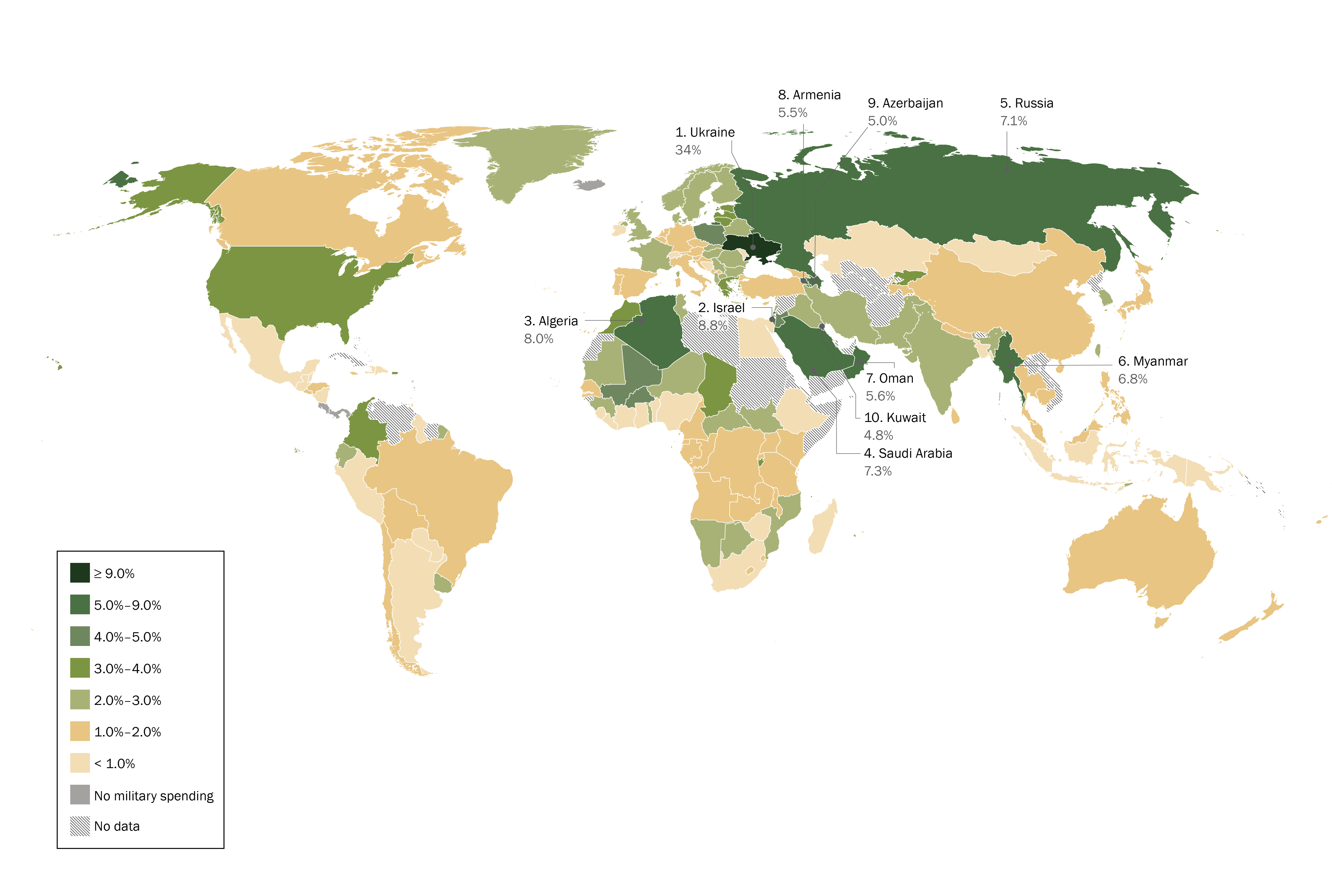
Figure 3. Military spending as a share of gross domestic product, by country, 2024
Note: The 10 countries with the highest military spending as a share of gross domestic product are labelled.
The boundaries used in this map do not imply any endorsement or acceptance by SIPRI.
Source: SIPRI Military Expenditure Database, Apr. 2025.
The SIPRI Military Expenditure Database, sources and methods
The SIPRI Military Expenditure Database provides military expenditure data by country for the years 1949–2024 in local current prices, constant US dollars, current US dollars, as a share of gross domestic product (GDP), per capita and as a share of general government expenditure. The SIPRI Military Expenditure Database was updated on 28 April 2025. This new data replaces all previous data published by SIPRI. The database and further details on the definitions, sources and methods used are available here.
All figures for spending in 2024 are given in 2024 current US dollars. Figures for relative increases or decreases in military spending—often described as changes in ‘real terms’ or adjusted for inflation—are expressed in constant (2023) US dollars.
SIPRI’s methodology for calculating military expenditure aims to provide comprehensive and transparent estimates and is therefore based on open sources. As a result, SIPRI’s data may not exactly match that published by the North Atlantic Treaty Organization (NATO) or other sources, which use different methodologies that may include certain categories of spending not always included by SIPRI.
SIPRI’s estimate of military aid to Ukraine in this year’s fact sheet includes financial contributions, training and operational costs, replacement costs of the military equipment stocks donated to Ukraine and payments to procure additional military equipment for the Ukrainian armed forces. However, it does not include the estimated value of military equipment stocks donated to Ukraine.
Definitions
Where possible, SIPRI military expenditure data includes all current and capital expenditure on (a) the armed forces, including peacekeeping forces; (b) defence ministries and other government agencies engaged in defence projects; (c) paramilitary forces, when judged to be trained and equipped for military operations; and
(d) military space activities. This data should include expenditure on personnel—which encompasses salaries of military and civil personnel and pensions and social services of military personnel—as well as expenditure related to operations and maintenance, procurement, military research and development, and military aid (in the military expenditure of the donor country).
Civil defence and current expenditure on previous military activities, such as veterans’ benefits, demobilization, conversion, weapon destruction and military involvement in non-military activities (e.g. policing) are excluded.
ABOUT THE AUTHOR(S)/EDITORS

Xiao Liang is a Researcher in the SIPRI Military Expenditure and Arms Production Programme.

Dr Nan Tian is a Senior Researcher and Programme Director of the SIPRI Military Expenditure and Arms Production Programme.

Dr Diego Lopes da Silva is a Senior Researcher in the SIPRI Military Expenditure and Arms Production Programme.

Lorenzo Scarazzato was a Researcher in the SIPRI Military Expenditure and Arms Production Programme.

Zubaida A. Karim is a Research Assistant in the SIPRI Military Expenditure and Arms Production Programme.

Jade Guiberteau Ricard is a Research Assistant in the SIPRI Military Expenditure and Arms Production Programme.
When peace is under threat, accurate information is more important than ever.
Invest in the facts